Hamilton Terminal Area
Hamilton Procedures
The HTMA procedures build upon information already contained in the NZHN Aerodrome Procedures, and any Controller logged on to HTMA shall be familiar with those procedures.
Positions
| Position Name | Shortcode | Callsign | Frequency | Login ID | Usage |
|---|---|---|---|---|---|
| Hamilton TMA | HTMA | Bay Approach | 125.300 | NZHN_APP | Secondary |
Note
Controllers shall note that HTMA is a secondary position therefore BAY must be staffed before a controller may log on HTMA.
Airspace
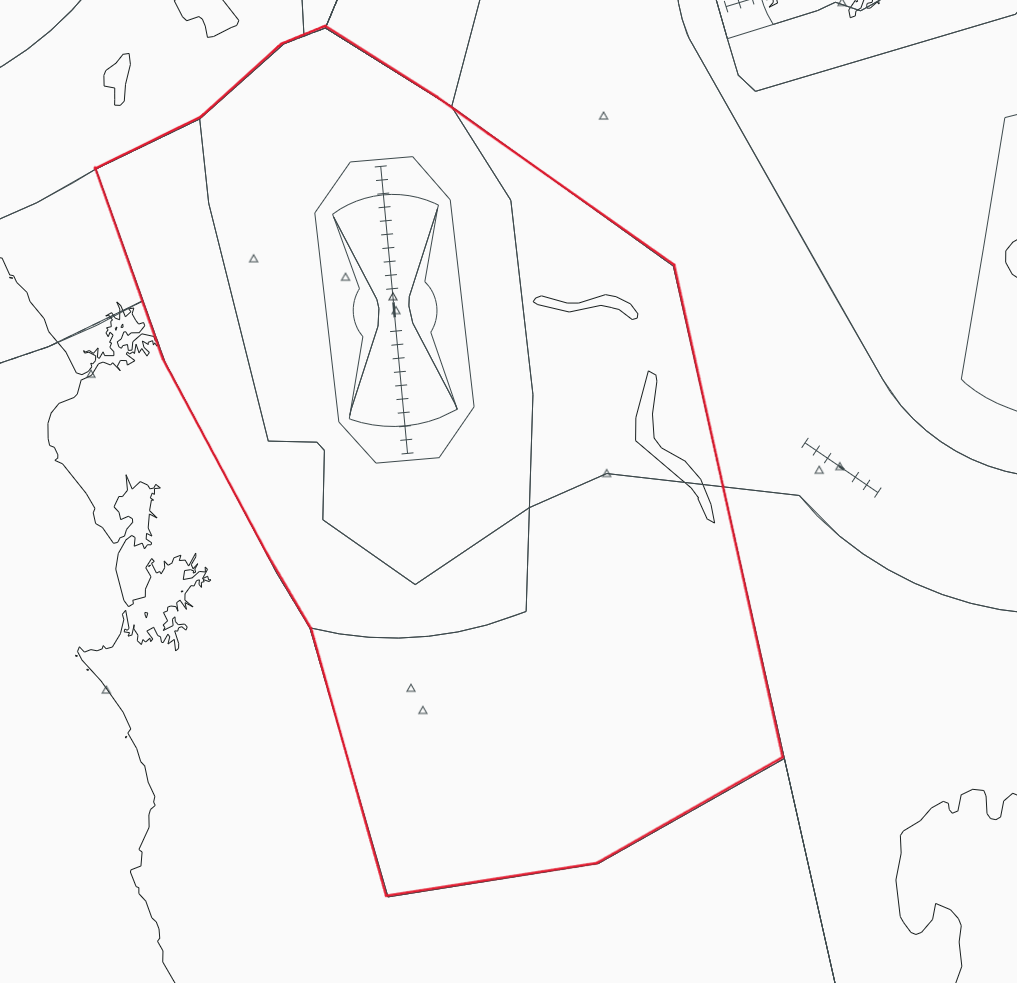
Hamilton CTA/C follows the lateral and vertical boundaries as shown below. HTMA has a vertical limit of A095. Controllers shall be aware of which frequency to hand aircraft to, as shown on the image below.
Transfer of Control Points
| Transfer Flow | Requirements | Notes |
|---|---|---|
| Tower -> Approach | Once the aircraft becomes airborne off the runway | Tower shall instruct all aircraft to contact HTMA airborne |
| Approach -> Control | Once the aircraft are approaching the lateral bounds | Aircraft may be handed off when nothing further is required of the aircraft |
| Control -> Approach | Once the aircraft is approaching the cleared level by control | Aircraft may not always be cleared to A110 when handed to HTMA |
| Approach -> Tower | Over the IAF (RNP) or established inbound on the VOR/DME |
Departures
HTMA may climb all domestic aircraft to their RFL.
International
International Flights departing to the west via UPLAR, MADEP and PEBLU have a restriction of A100 at LEKUS, this may be cancelled with coordination to RAN. All International departures may be climbed to FL250 by HTMA, with further climb from RAN.
Arrivals
All arrivals will be handed to HTMA prior to A110. HTMA may track shorten as required.
HTMA shall note that whilst RNP Z is available for all RNP capable aircraft, RNP Y is CAT A/B only.
Coordination
HTMA shall coordinate any non-nominated approaches with HTWR. Any track shortening outside of HTMA's CTA shall be coordinated with the appropriate ENR sector.